
'The prohibition regime has been accompanied by concerns regarding the expansion of the illicit liquor trade, increased enforcement challenges and corruption, and the growing use of alternative intoxicants, including illicit drugs.'

Bhalla will succeed former RBI deputy governor Subir Gokarn, who died in the US on July 30 after a brief illness.

He says a Budget is supposed to be about tax and expenditure. "I think he (Finance Minister Pranab Mukherjee) has outlined significant tax reforms, which will be implemented over the next three to six months."

Ahead of the upcoming budget, eminent economists during a meeting with Prime Minister Narendra Modi on Thursday urged the government to take steps to accelerate economic growth and improve infrastructure, sources said. The meeting was organised by the NITI Aayog on Thursday to elicit views and suggestions of economists for the first budget of the Modi 3.0 government. "Earlier today, interacted with eminent economists and heard their insightful views on issues pertaining to furthering growth," Modi said in a post on X.
Surjit Bhalla believes that RBI is the only central bank in the world that formed its monetary policy on the basis of the current account deficit. He also feels that the Chidambaram proposed women's bank in Budget to impress Sonia Gandhi.
The government move on wheat and cement is irrelevant
Surjit Bhalla of Oxus Investments says that he is worried about the equity markets as despite good earnings, stocks are refusing to go up and investors are using rallies to sell.

Former prime minister Rajiv Gandhi had said that well-meaning programmes meant for the poor did not reach them: the same is true of the NREGA, says Surjit Bhalla.
If instead of appreciating the nominal exchange rate it is devalued, the price level will rise
A ban on futures would lower liquidity and make the markets more volatile. In any case, the recent US experience shows such bans don't stop markets from falling.
The latest NCAER annual household survey, to use other data, points out that around 33 per cent of the bottom 40 per cent of households had a television set and another 12 per cent a two-wheeler in 2005 -- how they can all be poor is anyone's guess, says Sunil Jain.
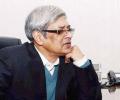
Headed by NITI Aayog member Bibek Debroy, the EAC includes NITI Aayog's Principal Advisor Ratan Watal as its member and economists Surjit Bhalla, Rathin Roy and Ashima Goyal as part-time members.

Under the new Monetary Policy Framework, the central bank aims to contain inflation at 4 per cent with a band of (+/-) 2 per cent.
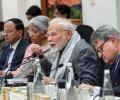
Job creation, improving farm productivity, and mobilising public funds for infrastructure development were some of the issues that figured during the interaction between Prime Minister Narendra Modi and economists ahead of the 2025-26 Union Budget. The prime minister on Tuesday met eminent economists and sectoral experts at NITI Aayog to hear their views and suggestions for the upcoming Budget. Union Finance Minister Nirmala Sitharaman is scheduled to present the Budget for 2025-26 in the Lok Sabha on February 1, 2025.

Among possible new members, former chief economic advisor Arvind Virmani's name is doing the rounds.
A book revolving around Prime Minister Narendra Modi's work and political and governance model with various chapters written by domain experts, his Cabinet colleagues and leading faces in different walks of life, is set to hit the bookstores next month.

The 14-member task-force will develop a working definition of poverty.

The 'BluFin Business Cycle Indicator', which reflects various macroeconomic trends on a monthly basis, stood at 166.3 points in May, 5.8 per cent higher compared to the same month last year, suggesting that the Indian economy is growing at a faster rate than the previous year.

Economic Advisory Council to the Prime Minister has identified ten themes, including economic growth and job creations that need attention.
The report by the High Level Advisory Group said India stands to benefit even more when the US and China are locked in a global trade war.

The council wants the government to stick to its fiscal consolidation road map.

New body to replace Plan panel might retain 40% of existing staff

'RCEP may be in India's long-term interest, but it is certainly not in India's short-term and medium-term interest.'

Reserve Bank of India Deputy Governor Viral Acharya is the eighth economist to quit since the Modi government took office.
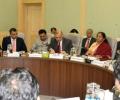
At a pre-Budget meeting, the FM was asked to ensure that NBFCs come out of the liquidity crisis they are facing with the help of RBI. They also spoke about the futility of trying to achieve a 3 per cent fiscal deficit target over the medium term.

The rising pitch of road shows and long rallies with hectoring pitches seem to have exhausted and numbed the audiences, rather than motivating them to vote for the party, observes Shreekant Sambrani.
Not at the moment, says FM; almost never, says his advisor.
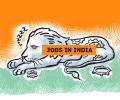
Most economists were of the view that the NSSO should release the data, as any move to withhold it will dent the image of country's statistical system.

'The decision to supply free food grains is not an economically sound decision because the government will find it very difficult in future to charge anything for food grains.'

In a paper, EAC-PM accused Subramanian of "cherry-picking high-frequency indicators" to express his skepticism about the growth rates after 2011-12.

Concerned by GDP slowdown and unrealistic tax targets, the economists urged Finance Minister Nirmala Sitharaman to implement long-term structural steps like land and labour reforms. Warning against any off-Budget financing the economists said the government should prepare a statement of intent for its social, rural and welfare sector expenditure.

ADB's calculations imply almost half of India's population (47.7 per cent) was below the line in 2010. Both these estimates are based on the year 2005's purchasing power parity rates.
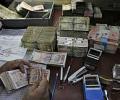
If you want to see our currency improve, then lower the interest rates, improve the growth and the rupee will rise, says Surjit S Bhalla.
If you want to see our currency improve, then lower the interest rates, improve the growth and the rupee will rise, says Surjit S Bhalla.

China and India are on different sides of the climate debate and, after the United States, Beijing has to make the most cuts.
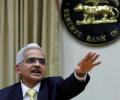
The MPC headed by RBI Governor Shaktikanta Das will announce the resolution of the meeting at around noon on Thursday.
